
Edwards Parole and Probation Compared
Parole and probation can both place rules on someone living in the community, but they begin in different places. The Texas Board of Pardons and Paroles decides parole and mandatory-supervision matters. After prison release, the TDCJ Parole Division supervises the person. Probation begins with an Edwards County court order. Texas calls it community supervision, and a Community Supervision and Corrections Department carries out the court's terms. Neither status should be inferred just because a name left the county jail roster.
| Record type | Who orders it | Who supervises it | Best confirmation |
|---|---|---|---|
| Parole | Texas Board of Pardons and Paroles | TDCJ Parole Division | BPP status channel and assigned parole office |
| Mandatory supervision | Statutory process with Board review where required | TDCJ Parole Division | TDCJ release status and supervision record |
| Probation or community supervision | County or district court | Community Supervision and Corrections Department | Court order and listed probation contact |
| Discharge | Sentence reaches its lawful end | No supervision under that completed sentence | Agency history and court record |
A bond release is different again. It ends the current jail hold while the case continues, and it does not create parole. The court may impose bond conditions, but those are not proof of a probation judgment. Start with the Edwards court file when the person came from the county jail. Start with TDCJ when the person came from a state prison or is known to have a TDCJ number.
Verify Edwards Post-Release Supervision
The strongest check follows the source of the release. A current county roster only addresses custody, and Edwards County's page does not publish supervision fields. The TDCJ inmate search is mainly a current-prison tool. A projected release date there is not proof that prison departure occurred. Use the status lines and supervising agency for parole, while the clerk and probation contact control court-ordered community supervision.
- Confirm the person's full legal name and collect a TDCJ number, SID, exact birth date, or Edwards cause number when available.
- Determine whether the release followed an Edwards jail case or a TDCJ prison term.
- For parole review before a vote, call the BPP status line at 844-512-0461. For release status after a favorable vote, call the Parole Division at 512-406-5202.
- For probation, obtain the judgment or community-supervision order from the Edwards County and District Clerk, then verify the assigned office with the county-listed contact.
- Ask the office to distinguish active supervision, discharge, a pending review, and a warrant or absconder record. Record the agency's exact wording and date.
For broader release proof, the Edwards County released-inmate search path explains how the sheriff's movement record and court order work together. Those records can show why custody ended even when no supervision followed.
Edwards Probation Contact in Brady
Edwards County's official directory lists an adult-probation contact in Brady, outside Rocksprings. That local fact matters. A person should not travel to the listed address, mail sensitive material, or assume it is the reporting site until staff confirm the current assignment. Community supervision follows the sentencing court and department structure, while a parole office assignment may follow an approved residence and caseload.
Adult Probation Listing
Quinn Martin
116 W. Main
Brady, TX 76825
Phone: 830-624-5452
Fax: 325-597-2123
Check the Edwards County contact directory and call before appearing or sending records.
For a state parole matter, TDCJ's Region IV directory lists the Del Rio District Parole Office at 903 E. 12th Street, Del Rio, with phone 830-775-4516. The directory does not promise that every Edwards County releasee reports there. The approved residence and current supervision assignment control, so the proper first question is which office owns the case.
The Edwards County and District Clerk is the record source when the assignment grew from a local judgment. Ask for the cause number, judgment, sentence, community-supervision order, and later modifications or discharge order. The combined clerk handles both county and district filings, but misdemeanors and felonies remain separate court matters. A state parole officer cannot rewrite a county probation order, and the Brady-listed probation contact cannot certify a TDCJ parole vote. Routing the question by record type avoids that common mix-up.
Edwards Supervision Status and Warrants
An approval vote does not produce instant release. TDCJ Review and Release Processing examines the residence plan, legal eligibility, disciplinary history, required programs, special needs, special conditions, and any detainer before a release certificate issues. A detainer is another agency's request to hold or take custody of a person. Thus, an approved person can remain confined while a plan, program, hold, or certificate is resolved.
Conditions vary by order and case. The official order or certificate is the authority, not a general online summary. If a person is described as an absconder, verify whether the responsible agency actually records a warrant or an unauthorized loss of contact. TDCJ publishes a Sex Offender Absconder Information Search, but that specialized search does not list every parole or probation absconder. The Texas DPS registry is also limited to people who have a registration duty. No match in either system clears a person of all warrants or supervision.
How Edwards Supervision Ends
Parole or mandatory supervision can end at discharge when the applicable sentence reaches its completion or maximum-expiration point. Probation ends under the governing court order, which may reflect successful completion, early termination if lawfully ordered, revocation, or another later ruling. A release from the jail is not the same event. The person may leave custody on bond while the court case and its conditions continue.
Ask TDCJ for incarceration and supervision history when a past state episode no longer appears clearly online. For an Edwards probation matter, request the judgment, original community-supervision terms, and later orders from the combined County and District Clerk. A clerk record can show the legal result, but it may not state the exact minute a jail physically released someone. Pair it with the sheriff's release or movement entry when timing matters.
Texas Government Code Chapter 508 governs parole and mandatory supervision. It also makes offense date and offense category important to eligibility. A simple sentence calculator cannot replace the Board record, TDCJ calculation, and actual discharge entry.
A past online result may not show the whole path. TDCJ's email information channel can provide current and prior incarceration information when given a full name and seven-digit TDCJ number. If that number is unknown, exact birth date can be used, or approximate age and county of conviction when necessary. Ask for parole release, supervision, and discharge details in plain terms. For probation, ask the clerk for the later order that closed or changed supervision. Keep the reply with the date requested because assignments and status can change.
Edwards Parole Review Milestones
The Board uses a three-member panel, and two concurring votes determine the result. TDCJ generally identifies a case about six months before initial eligibility and about four months before a later review. An institutional parole officer prepares a case summary, the designated Board office votes, and a denial carries a next-review date. An approval may carry special conditions. These are review milestones, not a daily Edwards County hearing calendar.
The official parole review sequence shows why eligibility, vote, and physical release must be read separately.
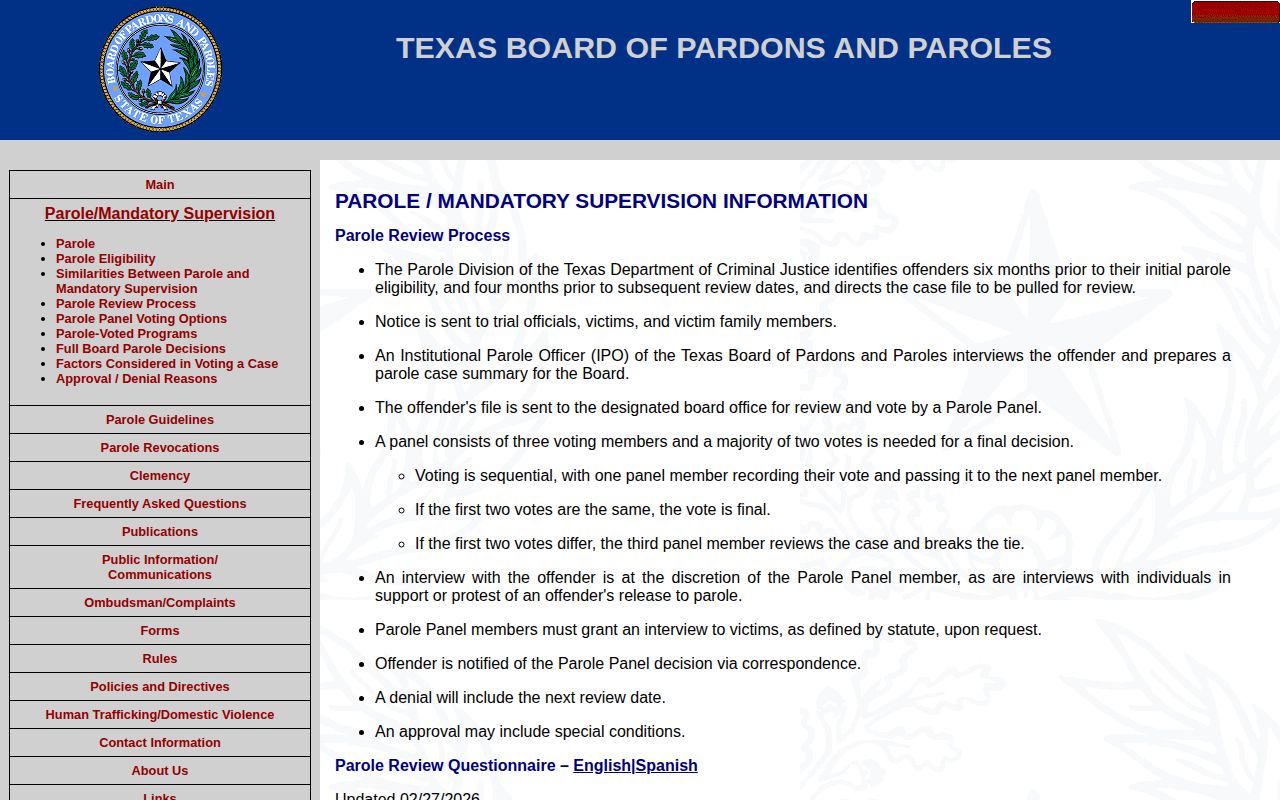
The sequence places investigation and voting before release processing. After a favorable result, verify the certificate and departure status through the Parole Division rather than treating the vote date as a release date.
Property After Edwards County Release
The Edwards County detention page provides a specific property process that can matter after a jail release. Belongings may be picked up Monday through Friday from 8 a.m. to 5 p.m., and the recipient must sign a property receipt. Clothing worn at arrest is retained. These are property-pickup details, not release-processing hours, and they do not tell a reader when someone will leave custody.
Call the Edwards County Sheriff's Office before pickup to confirm who may collect the property and what identification is required, because the published page does not answer those points. Also separate this local jail task from parole reporting. Recovering property does not prove a person met a TDCJ or probation condition, and a supervision appointment should not be delayed based on jail property hours.
The jail property rule also illustrates why agency labels matter. The Edwards sheriff controls property retained from a local booking. TDCJ controls property and release processing for a state prisoner, while another receiving jail controls items after transfer. If the roster carries a Briscoe notation, ask where the belongings are held before arranging pickup. The local office hours alone do not answer that question.
Keep practical release tasks separate from status research. A person may need property while a court case remains open, or may be on probation without ever having served a TDCJ sentence. Conversely, someone discharged from prison may have no Edwards probation case at all. The agency record, not the location of a personal item, resolves supervision.