
Edwards Projected and Actual Release
TDCJ uses the exact label Projected Release Date. Its Classification and Records Office calculates the date on which a state inmate is expected to leave incarceration if parole does not occur sooner. It is not the actual departure time. The maximum-sentence or discharge date is also a separate concept, as are parole eligibility and the next Board review date. Each label answers a different question.
An Edwards County pretrial detainee normally has no fixed release date. Bond may be posted, a judge may change the order, charges may be dismissed, or another agency may place a hold. A sentenced county-jail inmate may have an end point based on the judgment and jail credit, but the sheriff must still account for the controlling paperwork and holds. A TDCJ sentence uses the state calculation only after the person enters a qualifying TDCJ status.
Several dates can coexist in one file. A sentence date tells when the court imposed punishment. Parole eligibility tells when review may become possible. A projected release date expresses the state calculation under current facts. Maximum expiration marks a different endpoint. The jail's actual release time records the operational departure. Copying the date without its label creates a false answer, even if the numbers themselves were transcribed correctly.
Find an Edwards Projected Release Date
Begin with custody, not the name of the case county. The Edwards roster has shown people marked “IN BRISCOE UNIT,” proving that a local case list may include a remote physical location. A person at the Edwards County Detention Center follows the sheriff-and-court route. A sentenced state prisoner follows the TDCJ route. Federal and immigration custody have separate systems.
- Collect the legal name plus a booking number, cause number, TDCJ number, SID, or exact birth date.
- Confirm the current custodian. Do not equate an Edwards case with physical custody in Rocksprings.
- For TDCJ, use the official offender search and compare identifiers, offense, county, and location before opening the detail record.
- Transcribe “Projected Release Date,” “Maximum Sentence Date,” parole eligibility, and review information exactly as labeled.
- If TDCJ search fails, request information by email using the name and TDCJ number, or exact birth date when the number is unknown.
- For county jail, ask the sheriff and clerk for the judgment, sentence, jail credit, release calculation, holds, and actual release or movement entry.
The Edwards County release records guide covers the county request path in full. A court judgment gives the legal basis, while the sheriff record supplies the operational event.
Edwards TDCJ Good-Time Calculation
Texas Government Code Chapter 498 governs TDCJ good-conduct time. TDCJ awards credits by classification and participation rules, but Section 498.003 states that good-conduct time is a privilege, not a right. It does not reduce the court-imposed sentence itself. Credits affect eligibility or projected timing under the law that applies to the offense, and they may be forfeited for disciplinary violations or reduced classification.
Texas does not use one general “serve 85 percent” rule for every Edwards County case. Parole and mandatory-supervision formulas turn on the offense date, offense category, deadly-weapon findings, consecutive sentences, and statutory exclusions under Government Code Chapter 508. For some older eligible offenses, flat time plus good time can produce a mandatory-supervision calculation. For qualifying later offenses, Board approval may be discretionary. If mandatory supervision is denied, TDCJ may recalculate the projected date to maximum expiration.
TDCJ explains that for eligible offenses before September 1, 1996, projected mandatory-supervision timing can occur when flat time plus good time equals the sentence, unless parole comes first. For offenses on or after that date that remain eligible, the Board may have to approve release. Ineligible offenses generally carry a projected date matching maximum expiration unless parole changes the path. These rules show why offense date and eligibility must be read from official records instead of guessed from sentence length.
Why Edwards Projected Release Changes
A changed date is not automatically a data error. TDCJ recalculates when legal status, time credits, Board action, or sentence information changes. County timing can also shift when the court sends a later order or another agency asserts a hold. Ask which input changed rather than comparing two screenshots and assuming the newest one records a completed release.
| Factor | Possible effect | Where to verify |
|---|---|---|
| Good-time earning or forfeiture | Moves a TDCJ calculation under applicable law | TDCJ Classification and Records |
| Parole approval | May permit earlier release after processing | BPP result and Parole Division status |
| Parole or mandatory-supervision denial | Can leave or move the date toward maximum expiration | Board result and TDCJ detail |
| Detainer or hold | May cause continued custody or transfer | Holding and receiving agencies |
| Court order or amended judgment | Can change sentence credit or legal authority | Edwards clerk file |
| Release-plan or program requirement | Can delay physical departure after a favorable vote | TDCJ Review and Release Processing |
| Data correction | Changes the displayed field without a new custody event | Agency record custodian |
Confirm Edwards County Release Timing
For an Edwards jail episode, call the sheriff's 24-hour nonemergency line and follow with a narrow written request. Ask whether the person remains in Edwards custody, left for the community, or transferred. Request the actual release date and time, release type, and receiving agency when applicable. Then compare the jail event with the clerk's bond order, dismissal, judgment, sentence, jail credit, commitment, or probation order.
For TDCJ, the general inmate locator is 936-295-6371 or 800-535-0283 during listed weekday business hours. After a favorable Board vote, the Parole Division release-status line is 512-406-5202 and requires a TDCJ number, SID, or birth date. A notification can help with timing, but the Edwards County VINELink inmate search guide explains why current Texas IVSS alerts are not certified release records.
Edwards TDCJ Date Fields
The official TDCJ search starts with last name and at least a first initial. A TDCJ number or SID greatly improves identity control. When those are unavailable, compare gender, race, offense, county, and other fields shown by the live interface. A name match without those checks is weak.
The TDCJ offender search displays its search criteria and limitations.
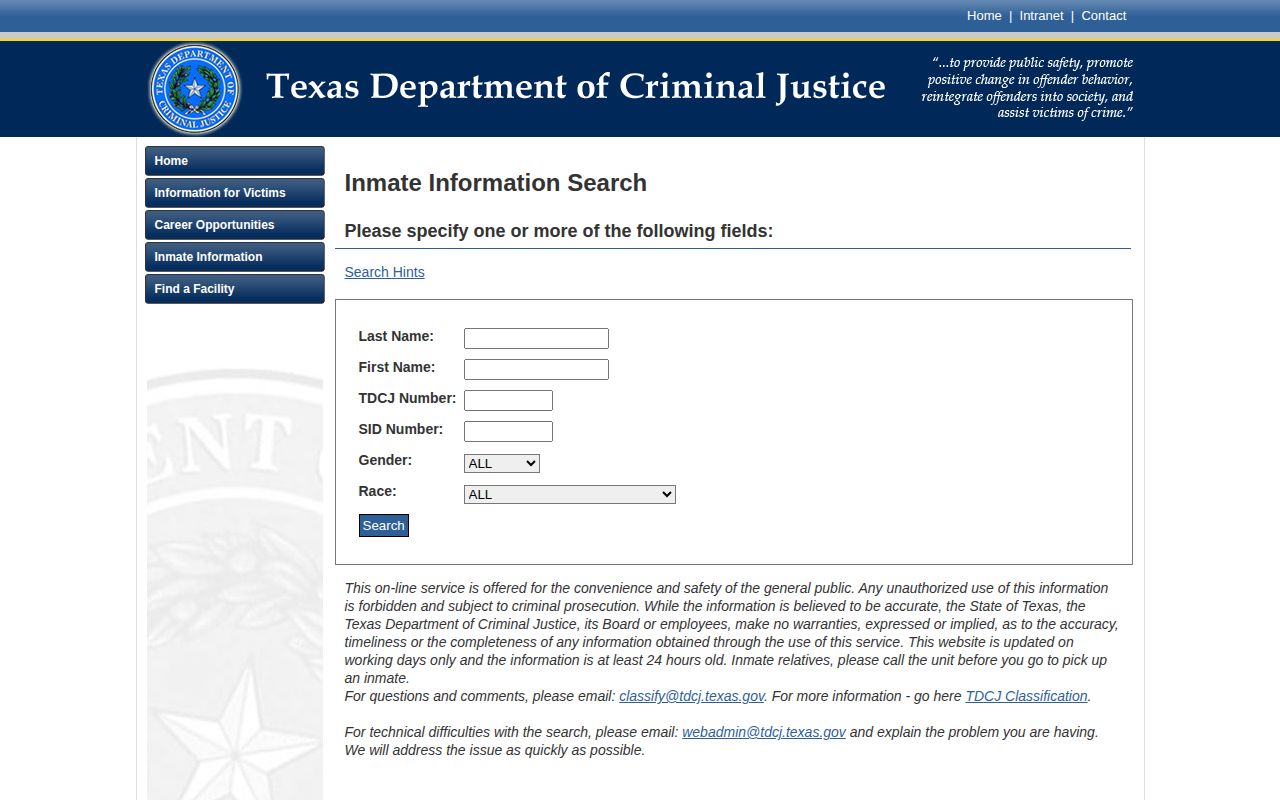
The screen is an entry point for current inmate information. When an older Edwards-linked prison episode no longer appears, TDCJ's email history request is the better route.
Edwards TDCJ Email Date Request
TDCJ says its email service can return the TDCJ number, location, conviction offense, current and prior incarceration information, and projected release date. Send the full name and seven-digit TDCJ number to pia@tdcj.texas.gov. If the number is unknown, provide exact birth date. When birth date is also unknown, TDCJ permits approximate age and county of conviction. Put the person's name in the subject line.
The agency states that this email service is free. It does not provide public photographs or Social Security numbers through that channel. Ask specifically for admission, actual release, release method, and supervision or discharge information when the question concerns a past event rather than today's projection.
Edwards Jail Date Has No Portal
The Edwards sheriff roster publishes names, charges, occasional Briscoe notes, and a page-level manual update date. It does not publish sentence calculations, booking dates, release dates, bond, or release reasons. No official 24-hour or 72-hour release feed was found. Therefore, a county sentence date cannot be calculated responsibly from that page.
Ask the combined County and District Clerk for the judgment, sentence, jail-time credit, and later orders. Ask the sheriff for the jail calculation and release or movement log. If the sources differ, ask whether another hold, amended order, or receiving agency explains the gap. Do not choose the record with the earlier date merely because it is more favorable.
Jail credit can be important, but the court record should state what credit was awarded and the sheriff should explain how it was applied. A bond amount or court date cannot be converted into a release prediction. Likewise, property-pickup hours and office business hours are not release hours. Edwards County publishes no reliable daily processing schedule, so exact departure timing must come from the completed release record.
The roster's visible manual update date was already old during the research review. That makes it unsuitable for measuring elapsed time or projecting a departure. Take note of the page date if using it as a lead, then call the sheriff's 24-hour nonemergency line for current status. Follow the call with a written request when a durable answer is required.
Edwards Parole Approval Is Not Release
TDCJ Review and Release Processing checks residence-plan compliance, disciplinary action, special needs, mandatory or discretionary supervision, special conditions, intensive-supervision criteria, required programs, and sex-offender criteria before issuing a certificate. Those steps can remain after the Board votes yes. A favorable vote date and an actual prison departure date are distinct.
The Board uses a three-member panel with two votes needed for a result. A denial includes a later review date, and an approval may include conditions. Eligibility itself depends on Chapter 508 and the law in effect on the offense date. This makes a short web calculator an unsafe substitute for the TDCJ calculation and Board record.
A detainer can change the practical result again. Another county, a federal authority, or immigration enforcement may take custody when TDCJ or Edwards releases its hold. The first agency's record may truthfully say released while the person remains confined elsewhere. Request the destination or receiving agency and then check that system. “Released from” and “released to the community” are not interchangeable.
After the date passes, replace prediction with history. Ask TDCJ for the actual release date, method, and supervision or discharge status. If the person went to another custodian, record that destination. If a parole term began, verify the assigned office. A past projected date without those later facts remains only evidence of what TDCJ expected at that earlier moment.